Dallas–Fort Worth
Tankless Water Heaters in Dallas–Fort Worth
A tankless heater makes hot water as you use it and never runs a tank dry. It also asks more of the gas line and the venting than a tank does, so the house gets checked before the unit gets ordered.
- Price given before work starts
- Nothing starts until you approve it
- Repair tested before the plumber leaves
The plain facts
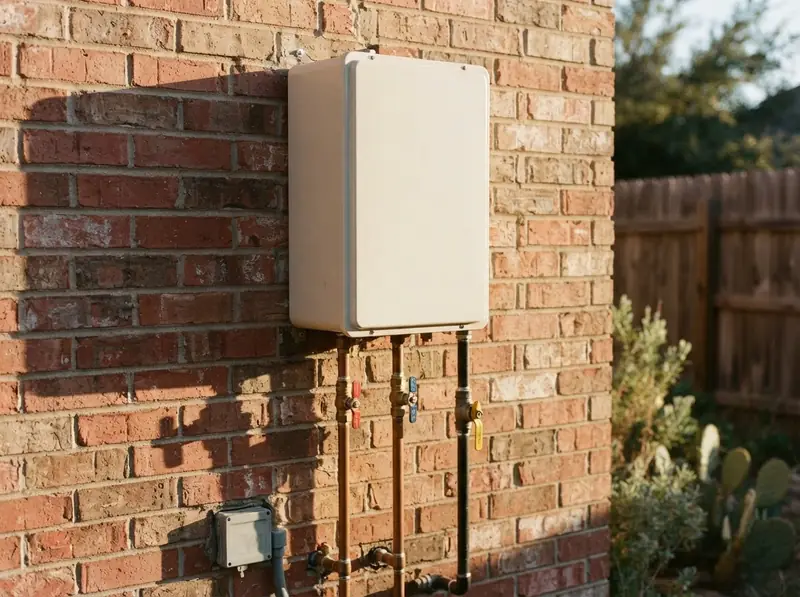
A tank keeps forty or fifty gallons hot day and night whether you need it or not. A tankless unit sits idle until a hot tap opens, then fires a large burner and heats the water on its way through. Done right, that means hot water for as long as the tap is open, and a heater that hangs on a wall instead of filling a closet.
Done wrong, it means lukewarm showers and error codes. Most tankless trouble comes from three places: a gas line too small to feed the burner, venting that was never right, or scale packed into the heat exchanger because nobody flushed it. We size a unit by how many fixtures run at once and how cold the incoming water gets in January. Gas, venting, drain and power all get checked before we recommend anything.
When tankless is worth a look
- The household runs the tank out of hot water most mornings
- The old tank is due for replacement and you'd like the closet or attic space back
- Your tankless unit shows an error code or shuts off mid-shower
- The water runs hot, then cold, then hot again
- The unit has gone more than a year without being descaled
No surprises
How the job goes
Check the house first
Gas meter and pipe size, the vent route, a drain for condensate, a power outlet, and how far the unit sits from the fixtures it serves.
Size it honestly
By gallons per minute at a winter temperature rise, not by the number on the box. The price includes any gas or venting work the unit needs.
Install it or service it
New units go in with isolation valves so they can be flushed later. Existing units get descaled, the inlet screen cleaned and the fault traced.
Run it under load
Several hot taps open at once, outlet temperature checked, then a walk through the controls and the flush valves so you know what you own.
How North Texas figures in
Two North Texas facts matter for tankless. The first is hard water. Scale coats the heat exchanger, and a unit that's never flushed starts losing output and throwing error codes within a few years, so plan on descaling about once a year. The second is the occasional hard freeze. Many units here hang on an outside wall, and their built-in freeze protection runs on electricity. In February 2021 a lot of them froze after the power went out. If a freeze and an outage arrive together, shut off the water to the unit and drain it.
Questions about tankless water heaters
Will a tankless heater work on the gas line I already have?
Sometimes. A tankless burner can use several times the gas a tank heater does, so the line that fed the old tank is often too small, especially over a long run. We add up the load on the whole system. Then you hear one of two things: the line you have is big enough, or here is what a bigger one would take.
Do tankless water heaters need maintenance?
Yes. In hard water the heat exchanger should be flushed with a descaling solution about once a year and the inlet screen cleaned. It's a short job when the unit has isolation valves, and it's the difference between a heater that lasts and one that doesn't.
Why do I get a burst of cold water from a tankless heater?
It usually happens when hot water is used twice in quick succession. The pipe still holds hot water from the first use, then comes a slug that passed through before the burner fired again. A unit that does it constantly, or cuts out at a low flow, may be scaled up, undersized or set wrong. That's worth having checked.